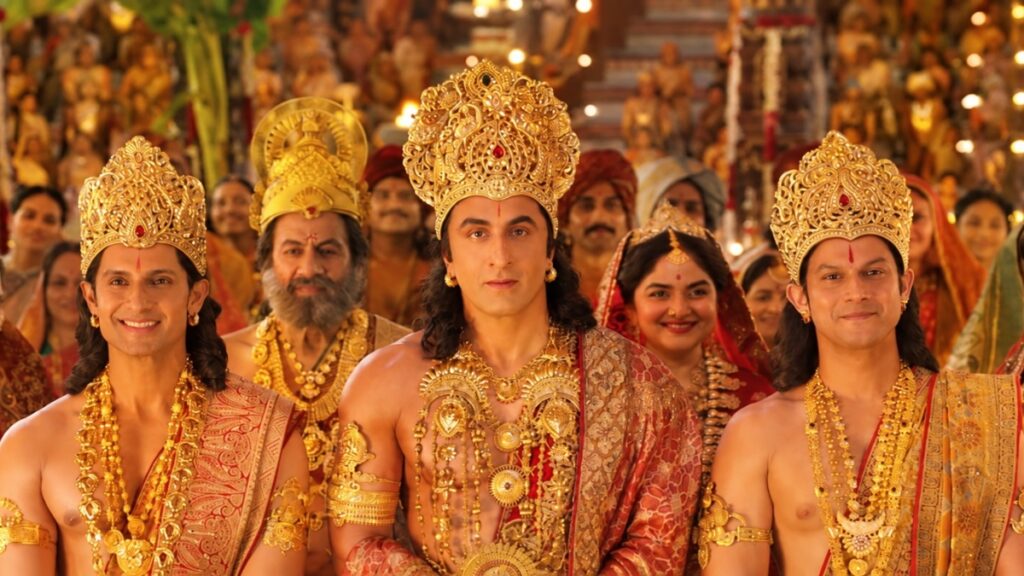
Some stories are so deeply woven into our culture that retelling them comes with a unique challenge. Audiences already know Lord Rama’s journey, Sita’s devotion, Ravana’s ambition and the battle between good and evil. The real question is not what happens next, but whether a filmmaker can make us feel the story all over again. Nitesh Tiwari’s Ramayana: Part 1, starring Ranbir Kapoor, Sai Pallavi and Yash, takes on that challenge with enormous ambition.
The film arrives as the first instalment of a planned two-part adaptation, bringing one of India’s most familiar epics to the big screen on an unprecedented scale. Its strongest achievement is the way it transforms familiar moments into cinematic spectacle, using visual effects, production design, music and performances to create a world that feels larger than life. While its storytelling and pacing do not always match its technical ambition, Ramayana offers an impressive beginning to a story that has been told for generations.
Ranbir Kapoor, Sai Pallavi and Yash Lead the Epic
Ranbir Kapoor approaches Lord Rama with restraint rather than theatrical grandeur. His performance relies on calm expressions, controlled body language and a sense of inner strength. Instead of playing Rama as an invincible warrior from the beginning, Ranbir gives the character a human quality that makes his journey more relatable. His quiet presence becomes especially effective in moments where duty, family and personal sacrifice intersect.
Sai Pallavi brings warmth and emotional sincerity to Sita. Her natural acting style helps ground the film’s grand visual world, giving the character a sense of dignity beyond her role in the larger conflict. The emotional connection between Rama and Sita is essential to the story, and Sai’s performance provides some of the film’s gentler, more intimate moments.
But Yash is the performer who brings the most commanding energy to the screen. As Ravana, he combines physical presence with intensity, creating a character who feels powerful, proud and dangerous. His introduction and major sequences give the film an imposing antagonist, while his performance adds another dimension to the familiar portrayal of Lanka’s king.
Ravi Dubey as Lakshmana also brings conviction to the role, reinforcing the loyalty and emotional bond at the centre of Rama’s journey. The ensemble helps make the world feel populated with characters rather than simply serving as a backdrop for the central spectacle.
VFX and Visuals: The Film’s Biggest Achievement
The visual effects are among Ramayana Part 1‘s most impressive elements. From the grandeur of Lanka to the forests surrounding Rama’s exile, the film builds a mythological world that demands a theatrical canvas. The scale is evident in its landscapes, elaborate environments, battle sequences and larger-than-life imagery.
The work by DNEG gives many scenes a striking sense of depth and atmosphere. The film’s strongest visual moments do not rely only on size; they use composition, lighting and movement to make the world feel alive. The contrast between Rama’s forest journey and Ravana’s powerful kingdom helps establish two very different spaces within the same epic.
The action sequences are staged with a clear emphasis on spectacle, particularly the confrontations involving Ravana and the moments that hint at the larger conflict to come. The Jatayu sequence has emerged as one of the film’s widely discussed visual highlights, combining scale, movement and emotional stakes.
However, the effects are not equally convincing in every scene. Some digital environments and creatures can feel overly artificial, reminding viewers of the technology behind the image rather than allowing them to remain immersed in the story. This is a noticeable limitation in a film whose greatest strength is its attempt to create a believable mythological world.
Even with those uneven moments, the overall visual ambition is impressive. Ramayana demonstrates how Indian cinema can use large-scale effects to bring a culturally significant story to a global theatrical audience.
A.R. Rahman and Hans Zimmer’s Music Adds Scale
The film’s music brings together two major composers, A.R. Rahman and Hans Zimmer, creating a score that aims to blend Indian musical traditions with a sweeping international sound. The background score is particularly effective during emotional and action-driven sequences, adding weight to moments that might otherwise feel purely visual.
The music helps establish the film’s spiritual atmosphere, especially when the story moves away from large battles and focuses on Rama, Sita and their relationships. At its best, the score gives familiar scenes a sense of emotional elevation without overwhelming the performances.
The songs, however, may not leave the same lasting impression for every viewer. Some musical passages feel more integrated into the narrative than others, and the balance between devotional emotion and cinematic grandeur occasionally feels uneven.
Still, the background score remains one of the film’s important strengths. It gives the epic a distinct sonic identity and helps connect its intimate character moments with its larger-than-life spectacle.
Where the Storytelling Could Have Been Stronger
The biggest challenge for Ramayana Part 1 is its pacing. The film has a vast story to establish, several important characters to introduce and a mythology that cannot be reduced to a simple action narrative. At times, the film spends so much energy building its world and staging major sequences that the emotional momentum slows down.
The familiar nature of the story also places greater responsibility on the screenplay. Viewers do not need every major event explained from scratch; they need fresh emotional insight into characters they already know. The film succeeds when it focuses on Rama’s choices, Sita’s strength and Ravana’s ambition, but some stretches feel more concerned with spectacle than dramatic progression.
The decision to divide the epic into two parts gives the filmmakers room to develop the larger conflict, but it also means the first instalment must stand on its own while preparing audiences for what comes next. The ending leaves the story moving toward its most significant confrontation, making the sequel an essential part of the overall experience.
Final Verdict: A Grand Beginning Worth Experiencing
Ramayana: Part 1 is an ambitious cinematic retelling that finds its greatest strength in visual spectacle, committed performances and an evocative musical score. Ranbir Kapoor brings grace to Rama, Sai Pallavi adds emotional warmth as Sita, and Yash gives Ravana the commanding presence a larger-than-life antagonist requires.
Its visual effects raise the scale of Indian mythological filmmaking, even if some digital elements remain uneven. The music enhances the emotional and dramatic moments, while the storytelling occasionally struggles to maintain momentum across its expansive runtime.
The film may not reinvent every aspect of an epic audiences already know by heart, but it succeeds in making that familiar journey feel cinematic again. For viewers drawn to mythology, grand visuals and emotionally grounded performances, Ramayana Part 1 offers a compelling theatrical experience and a promising foundation for the next chapter.
Verdict: A visually ambitious and emotionally sincere retelling, elevated by Yash’s commanding Ravana, Ranbir Kapoor’s composed Rama and a powerful musical backdrop. Its pacing could be tighter, but the spectacle makes it a memorable beginning.