Nayanthara returns as the divine force in Mookuthi Amman 2, but this time the franchise takes a considerably different route. Directed by Sundar C, the sequel moves away from the social satire and contemporary humour that made the 2020 original entertaining, embracing a much larger mythological fantasy involving ancient rivalries, supernatural powers and a battle between good and evil. Featuring Nayanthara, Regina Cassandra, Duniya Vijay and Urvashi, the film attempts to deliver a grand devotional entertainer for theatrical audiences. Unfortunately, despite its impressive premise and elaborate production design, the screenplay struggles to give the spectacle enough emotional weight.
The biggest question surrounding the sequel was whether Sundar C could retain the original film’s distinctive appeal while expanding its mythology. The answer is somewhat disappointing. There are entertaining moments, particularly when Nayanthara appears in her divine avatar, but the film frequently mistakes visual scale and an overcrowded narrative for engaging storytelling.
Mookuthi Amman 2 Story: A Battle Between Good and Evil
The story follows Shakthi (Nayanthara), a police officer who begins experiencing strange recurring nightmares involving a village called Mylanchi. Her visions repeatedly feature supernatural events and a mysterious warrior, eventually pushing her towards the village to understand their connection.
Meanwhile, the film introduces an ancient conflict involving a powerful evil force and the goddess Mahashakthi. The narrative moves between the present and events from approximately 2,000 years ago, gradually connecting Shakthi’s visions with an old rivalry involving Bhaira (Regina Cassandra).
The central conflict revolves around Bhaira’s revenge and the supernatural forces threatening the goddess. As the story progresses, Shakthi discovers her connection to the divine world, leading towards a confrontation that determines the fate of those caught between good and evil.
The premise offers considerable potential for a devotional fantasy thriller. However, the screenplay introduces so many characters, supernatural elements and subplots that the central conflict occasionally loses its impact.
Nayanthara and Regina Cassandra Are the Biggest Highlights
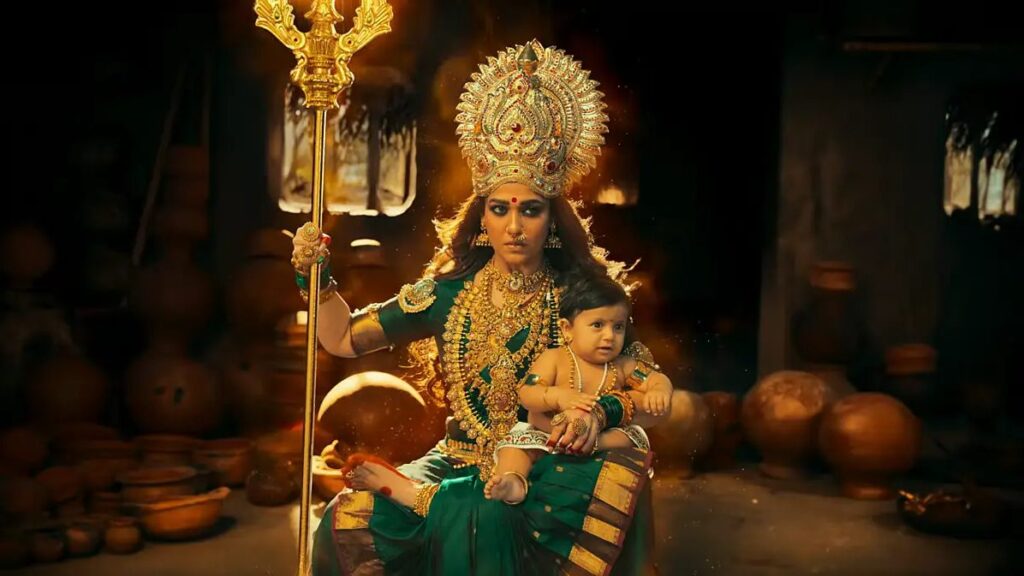
Nayanthara remains the film’s principal attraction. The actress looks convincing in her divine appearance and brings the screen presence required for a character associated with such a powerful mythological identity. Her transformation into Mookuthi Amman provides some of the film’s more visually appealing moments.
However, her portrayal of Shakthi in the contemporary portions is less satisfying. The character frequently appears frightened and dependent on other people, leaving limited room for the strength and personality audiences might expect from the central protagonist. The writing also becomes repetitive, particularly when similar reactions are used across multiple situations.
Regina Cassandra makes an impression as Bhaira, the principal antagonist. Her character has an interesting connection with the goddess, and the historical rivalry provides the film with an opportunity to establish a compelling villain. Regina brings considerable intensity to the role, although the character’s appearance and dialogue delivery do not always work in her favour.
Urvashi is another welcome presence. Playing Shakthi’s mother, she brings natural humour and emotional warmth to the proceedings. Duniya Vijay, making his Tamil debut with the film, delivers a decent performance, while Yogi Babu receives limited opportunities to create the kind of comedy audiences generally expect from him.
The supporting cast also includes Sunil, Ramachandra Raju, Abhinaya and several familiar performers. However, the overcrowded screenplay does not give everyone enough space to make a lasting impression.
What Works and What Doesn’t in Mookuthi Amman 2?
Sundar C deserves some appreciation for attempting to create a larger mythological universe. The historical portions, elaborate production design and supernatural atmosphere give the film a different identity from its predecessor. The interval sequence is among the more engaging portions, providing the narrative with a much-needed moment of excitement.
The climax also attempts to deliver the grand theatrical spectacle expected from a devotional fantasy. A lengthy confrontation involving the principal characters, energetic action and devotional music gives the final portion some visual energy.
Hiphop Tamizha’s background score helps establish the devotional atmosphere, particularly during important confrontations. Gopi Amarnath’s cinematography captures the elaborate sets and mythological environments effectively, while Fenny Oliver’s editing contributes to the transitions between different timelines.
However, the technical achievements cannot completely hide the screenplay’s problems.
The biggest disappointment is the lack of emotional connection. Devotional films generally need more than supernatural battles and larger-than-life characters to make audiences care about their central conflict. The original Mookuthi Amman understood this by combining humour with social commentary about blind faith and the exploitation of religious beliefs.
The sequel largely abandons that approach. Instead, it follows a familiar good-versus-evil formula, with witchcraft, supernatural powers and an ancient rivalry driving the narrative. The comedy also feels underdeveloped, making several scenes less entertaining than intended.
The visual effects are another weakness. Despite the film’s ambitious scale, some supernatural sequences look artificial, reducing the impact of moments that should have felt genuinely spectacular. The extensive use of computer-generated imagery and AI-assisted visuals does not always blend naturally with the live-action portions.
The second half also struggles to maintain consistent momentum. The film moves quickly between characters and conflicts, leaving insufficient time to develop emotional stakes. A tighter screenplay and more carefully executed visual effects could have made a considerable difference.
Mookuthi Amman 2 vs Mookuthi Amman: Does the Sequel Match the Original?
The biggest difference between the two films is their storytelling approach. RJ Balaji’s 2020 original used religious fantasy as a foundation for comedy and social satire, questioning how self-proclaimed spiritual leaders exploit people’s beliefs. Its humour and contemporary setting gave the film a distinctive identity.
Sundar C takes the franchise towards traditional mythological fantasy, with a historical backstory and a larger supernatural confrontation. This direction is not necessarily a bad idea, but the sequel needed a stronger narrative to justify the change.
Unfortunately, Mookuthi Amman 2 does not offer the same freshness or entertainment value. It may appeal to viewers who enjoy conventional devotional dramas, but those expecting the original’s combination of humour, social commentary and engaging storytelling could leave disappointed.
Final Verdict: Is Mookuthi Amman 2 Worth Watching?
Mookuthi Amman 2 has an interesting premise, an impressive ensemble and Nayanthara’s commanding presence, but its execution falls short of expectations. Regina Cassandra provides some engaging moments, Urvashi brings warmth to the film, and the production design deserves appreciation for creating an elaborate mythological setting.
However, the predictable screenplay, inconsistent comedy and underwhelming visual effects prevent the film from becoming the grand devotional entertainer it wants to be.
Nayanthara’s return is the biggest reason to consider watching the sequel, particularly for audiences who enjoy mythological fantasy. Nevertheless, the film does not come close to recreating the charm of the original.
Rating: 2/5
Verdict: Mookuthi Amman 2 has the scale of a grand devotional fantasy but lacks the storytelling, humour and emotional connection needed to make it memorable. Nayanthara shines in her divine avatar, but even her screen presence cannot completely rescue this disappointing sequel.